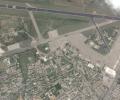
The Pakistani government has once again found itself embarrassed on the world stage, now acknowledging the impact of India's strategic and precision strikes on its military installation during the escalation in May, following Operation Sindoor, which came in retaliation for the April 22 Pahalgam terror attack that killed 26 civilians.
Pakistan's Prime Minister Shehbaz Sharif admitted that India's ballistic missiles hit Nur Khan Airbase and other sites on May 10, a rare acknowledgement that contradicts Pakistan's usual stance of denial when it comes to Indian military action.

The strikes targeted the Nur Khan Airbase in Rawalpindi, the 12th Brigade base in Quetta, Balochistan, and the Khoizai camp in the Mohmand Agency in Khyber Pakhtunkhwa, along with other military sites housing key facilities and centres.
A new report alleges Pakistan shielded Iranian military aircraft from potential US airstrikes, raising questions about its role as a neutral mediator in the ongoing US-Iran tensions.

Iranian President Masoud Pezeshkian is on a state visit to Pakistan to discuss the full implementation of an agreement signed between Iran and the US, alongside regional and international developments. The visit also aims to strengthen bilateral cooperation across various sectors, following recent high-level talks between the US and Iran in Switzerland regarding regional security.

Pakistan has increased security measures in Islamabad and surrounding areas as the US and Iran prepare for another round of peace talks. The move follows an announcement by former US President Donald Trump that American negotiators would be in Pakistan for discussions aimed at resolving the conflict between the two nations.

Donald Trump issued a fresh warning to Iran as negotiations remained deadlocked over uranium stockpiles, sanctions relief and war compensation. The US President's sharp remarks came just hours after Iranian media revealed Washington's core conditions for resuming negotiations.

Iranian Foreign Minister Abbas Araghchi visited Pakistan for the second time in three days amid uncertainty surrounding potential peace talks with the US. The visit follows discussions in Oman regarding regional security and efforts to resolve the Iran-US conflict.

Pakistan is hosting a quadrilateral summit of foreign ministers from Saudi Arabia, Egypt, and Turkiye to discuss the conflict in West Asia and explore avenues for peace. The summit includes discussions on regional developments and meetings with Prime Minister Shehbaz Sharif.

High-level peace talks between the US and Iran, facilitated by Pakistan, aim to de-escalate the conflict in West Asia and potentially reshape regional stability.

As the negotiations continued, the Iranian government said on social media that "talks between Iran and the US in Islamabad entered the expert-level stage as economic, military, legal, and nuclear committees joined in".
India's strikes on Pakistan damaged runways and structures across at least six airfields, according to a visual analysis by The Washington Post, which experts said were the most significant attacks of their kind in decades of simmering conflict between the two nations.
The collective West has always opposed strong leaders and economic development in India, asserts Colonel Anil A Athale (retd).

Asian Cricket Council chairman Mohsin Naqvi, who is also the PCB chief, walked away with the Asia Cup trophy after India refused to take the silverware from his hands.
What was the aim of Operation Sindoor? Why was the operation halted so soon? asks Lieutenant General Prakash Katoch (retd).
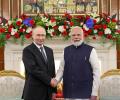
Luckily for us, a Russia that is desperate to stay relevant in an emerging multipolar world finds in India a reliable geostrategic partner. The Russian proximity to India also keeps China from exploiting its economic dominance vis a vis Russia, points out Colonel Anil A Athale (retd).
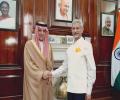
The Saudi statement came as tensions soared significantly, with Pakistan claiming that its three airbases were targeted by Indian missiles and drones early Saturday.

The Air Chief revealed information about India's damage to Pakistan's defence capabilities while addressing an event at the Hal Management Academy in Bengaluru on Saturday.
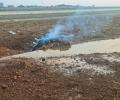
Dar's statement, echoed by another federal minister, came as the Indian and Pakistani militaries targeted each other's installations using missiles in the last more than 12 hours, further escalating the already tense conflict situation.
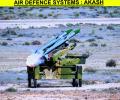
'The Pakistanis called the US state department and said we agree with India on peace.' 'It was then that US President Donald Trump jumped in and took credit for the ceasefire.'
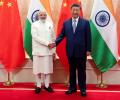
'If they can be duplicitous, we can be equally duplicitous.' 'If they offer friendship, we reciprocate.' 'If they choose hostility, we respond with equal hostility.'

Citing details of the contract from the American Federal Procurement Data System, the BBC report claimed that Pakistan signed two contracts with American companies named "Global Military" and "Northrop Grumman" for the sale of 155mm shells.

'The fight against terrorism will continue. We have set a new normal and the new normal is that we will follow an offensive strategy. Wherever terrorists are, we have to kill those terrorists and we have to destroy their infrastructure. So it is still not over but as we speak the ceasefire is still intact'

Pakistan military spokesperson Lieutenant General Ahmad Sharif Chaudhry told a hurriedly called press conference in Islamabad at around 4 am that th Pakistan air force's Nur Khan (Chaklala, Rawalpindi), Murid (Chakwal) and Rafiqui (Shorkot in Jhang district) airbases were targeted.

'The lesson Beijing would have learned is that there is, cost-benefit wise, no better option than to keep the Pakistan military supplied with its most advanced armaments, certain that in hostilities with India these would be used for maximum effect.'
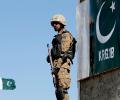
In September, the contingent was trained by FIFA's eight-member training team during their visit to Pakistan.
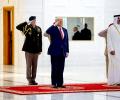
'He is intrigued by the intractability of Kashmir issue. With his interest in dealmaking and peacebrokering, he sees it as an exciting challenge to tackle.'

'There's a lot of sense in what Prime Minister Modi did, but the Indian government has to be really prepared for a really sharp escalation spiral.'
'We do not want to fall into a trap of uncontrolled escalation or all out conflict.' 'When the need arises we will do that.'

It is the first time in nearly nine years that India's foreign minister travelled to Pakistan even as the ties between the two neighbours remained tense over the Kashmir issue and cross-border terrorism emanating from Pakistan.

The brief exchange and handshake between Jaishankar and Sharif took place at a banquet dinner hosted by the Pakistani prime minister at his residence in honour of the delegates attending a summit of the Shanghai Cooperation Organisation.
Former Air Marshal Nur Khan accused former military ruler Ayub Khan and his generals of telling a 'big lie' to the nation by saying India had provoked the war.
Former ruler Ayub Khan launched a secret operation in 1965 to send infiltrators into Jammu and Kashmir.
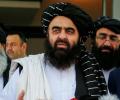
Acting Foreign Minister of Afghanistan, Amir Khan Muttaqi, on Wednesday arrived in Islamabad, his first visit to the country, as part of efforts by the two sides to reset their ties in the wake of the Taliban's takeover of Kabul.

Reader Nur Darina Ghazali has sent us a photograph with a star.

Uzbekistan lives comfortably in several centuries but is also a forward-looking nation, Deepa Gahlot discovers on a visit to this Central Asian country.

The royal couple, who are on a five-day tour of Pakistan, took a ride in a decorated rickshaw fitted with lights to arrive at the venue of the dinner.

Musharraf, 79, was suffering from amyloidosis, a rare disease caused by a build-up of an abnormal protein called amyloid in organs and tissues throughout the body, The Express Tribune reported.

The bodies of the victims of helicopter crash, including ambassadors of Norway and the Philippines and wives of Indonesian and Malaysian envoys to Pakistan, were brought to Islamabad on Saturday from the site of accident.

'I somehow felt that Muzaffar Ali was in Aligarh to feel the pulse of the Muslim youth, especially in the darker and harsher times that India is passing through,' notes Mohammad Sajjad.
